
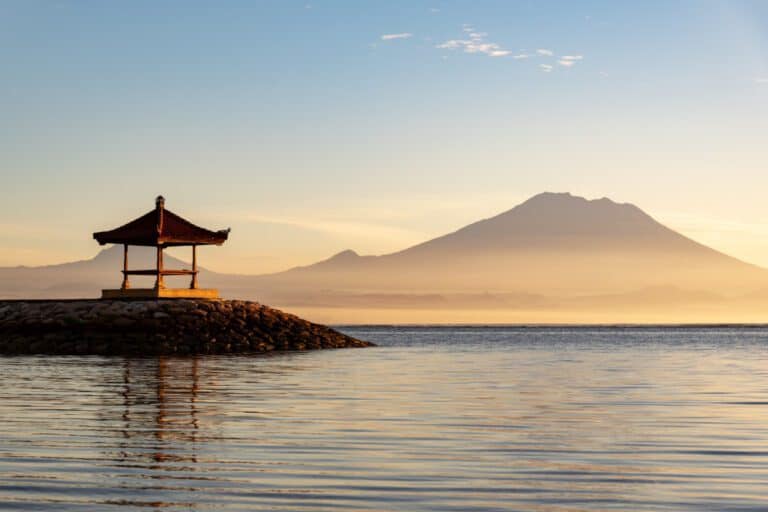
On a tumultuously humid afternoon in Sanur, I’m wrapped in the smell of fish, the ocean, and my own sweat. The fatigue of a long flight sits heavy, an in-between feeling, neither entirely pleasant nor unpleasant, but edged with quiet excitement.
“Welcome to Sanur,” the woman at check-in says, placing a chilled drink in my hands. It’s made with passion fruit. I take a sip—sweet, sour, distinctly tropical—and just like that, a sense of ease sets in, shaping the unhurried days ahead.
The Sacred Roots Of Sanur
Sanur draws its name from two Sanskrit-derived words: saha (together) and nuhur (to visit, or something sacred). Home to generations of Balinese fishing families—many of whom still live and work here—it began as a quiet coastal village on the island’s south-eastern edge. Yet, unlike much of the island’s rapid transformation, it has managed to hold its balance—where history and progress don’t compete, but coexist with ease.
Following The Main Street To The Heart Of Sanur
Needing caffeine to start my day of exploring, I’m lucky my hotel the Hyatt Regency sits right on Sanur’s main street—the stretch lined with restaurants, warungs (modest roadside eateries), and small shops.Roti bakar, a crisp, buttery toast with sweet fillings, is a local delicacy.
Its age reveals itself not in wear, but in its architecture: deeply rooted in Balinese design, almost ancient in spirit.
It’s here I realise I’m exactly where I need to be—because both of us have something to say about Sanur: me, and this quiet piece of history that has witnessed five decades of it.
I set out on foot and spot Seta Coffee almost instantly: a modern, minimal roastery, its aroma spilling onto the road as if calling you in.
Thoughtfully designed, it serves exceptional locally sourced coffee, great matcha, and a standout beef and horseradish sandwich. Caffeinated and well-fed, I begin walking again.Seta Coffee serves exceptional good locally sourced coffee
The main street runs parallel to the beach, branching into smaller lanes that lead you to the sea. My hotel sits somewhere in the middle, so on day one, I take a left. The streets unfold slowly: food stalls, family-run restaurants, souvenir shops, massage parlours, guesthouses—and every few metres, a temple.
Somewhere along the way, I arrive at Pescado, a Spanish tapas restaurant known for its fresh seafood. The scallops baked in their shells, garlic prawns, and seafood paella are worth stopping for.
By late evening, after hours on foot, the heat begins to catch up. One of Sanur’s quieter pleasures reveals itself in its massage parlours—easy to miss, easier to give in to. I walk into UR Spa, and within minutes, the fatigue of the journey fades.
Back on the street, what stands out most is the presence of locals—not just those working, but those living, strolling, existing within the same spaces. It’s something that feels increasingly rare in more saturated parts of Bali like Ubud, Uluwatu, or Canggu.
In passing, I’m told the waters of Sanur are blessed. Swim here, they say, and you carry that blessing with you. I make a mental note for the next day.
Further down the road, I notice a crowd gathering—split across both sides of the street. For a moment, it feels like the start of chaos. But it’s something far sweeter: a line for gelato. Massimo, a 30-year-old institution, draws crowds for its homemade flavours. Two generous scoops—chocolate and hazelnut—in a waffle cone for just ₹110. Overfed and riding a sugar high, I make my way back to the resort.
Ribs, Rituals, And Calming Waters
The following day, I have more to explore, armed with a few mental notes, thanks to the hotel staff and conversations from the night before. I start at Sala Bistro with an iced long black, then take a right from the hotel—the opposite direction from the day before.
Much like the other side, this stretch is dotted with beautiful cafés—minimal, inviting, and effortlessly stylish. But lunch, today, has to be local. I cut through an internal lane from the main market and find my way to Naughty Nuri’s, a warung known for its barbecue pork ribs. I wouldn’t mind flying back to Bali just for these—juicy, tender, perfectly balanced between sweet and spice.
Back on the main street, I drift through a few small shops before stopping at Barito Leather, a local Balinese designer known for its handmade pieces.
From here, the road opens up to the boardwalk—a long stretch running alongside the beach. I remember what I was told the evening before—that the waters of Sanur are blessed. With the sea just a few metres away, I decide it’s time.
The water is calm, almost unusually so, with waves breaking far out, making it perfect for a long, unhurried swim. One dip turns into a few.
The beach mirrors this same ease: a boardwalk lined with restaurants tucked into pockets. People walk, cycle, children attempt to fly kites. I stop for a quick bite at the pizzeria at my hotel, set right on the beach. There’s no concept of private beaches here; anyone could have walked in and shared a slice. No one did.
After a shower and some rest, I head out for dinner—another local recommendation: a small, unassuming warung called Little Bird. The drinks are made with arak, Bali’s local rice spirit, and the food is bold, spicy, and deeply comforting—mie goreng, ayam lalapan goreng, ayam asam manis, and a mixed seafood grill. There couldn’t have been a better way to end the day.
A Perfect Last Meal
On my final day, the arak from the night before has me sleeping later than I’d like. An afternoon swim in the ocean fixes that instantly. I make my way to Pura Blanjong, a temple that houses a 10th-century pillar—quietly grounding, a reminder of how temporary everything else feels.
Back on the main market street, I pick up a few things to take home—shell, jute, bamboo. Not necessarily local in origin, but somehow true to the feeling of Sanur.
Dinner is at Sindhu Night Market, a local food market buzzing with energy. I try almost everything: chicken satay, mie goreng, nasi campur, roti bakar. It turns out to be the best meal I’ve had in Sanur.
One moment stays with me. At a nasi campur stall, the vendor asks me to choose. I don’t—I trust him instead. He hands me a cone: rice layered with an assortment of dishes, something spicy on top. The taste is unforgettable.
What Sanur Leaves With You
On my last walk along the boardwalk, the ocean breeze hits my face—and I find myself, once again, wrapped in the smell of fish, the
sea, and my own sweat. Only this time, it feels different. Familiar. Almost comforting.
I wish I could take some of this back home, the massages, the gelato, the pork ribs, the nasi campur, the arak, the blessed water. But I can’t. All I carry back are photographs, the quiet assurance of those swims, memories that feel larger than the days they came from, and a promise to return to the unhurried coast of Sanur, where Bali slows down.
Source: Travel and Leisure Asia