According to Captain Lawrence, a 30-year resident of Bali, successful realtor, and property developer, there is virtually a minuscule chance of any physical harm coming to you as a result of the current elevated volcanic activity across Indonesia.
The mainstream press and social media influencers thrive on playing these stories up because fear sells and sensational headlines attract clicks.
But having lived here for three decades, I have learned that headlines rarely reflect reality on the ground.
The only time anyone on the island ever legitimately had to consider direct volcanic fallout was when Mount Agung erupted several years ago for the first time in over half a century—and even then, the official hazard perimeter extended just 12 kilometers from the crater. The rest of the island carried on with business as usual.
Understanding the Map:
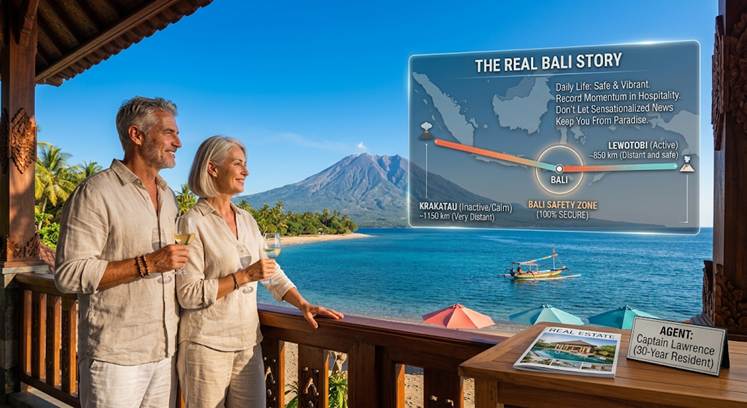
The only practical concern travelers ever face during Indonesian volcanic activity isn’t ground safety—it’s high-altitude ash plumes that can periodically disrupt air traffic. However, geographic context changes everything.
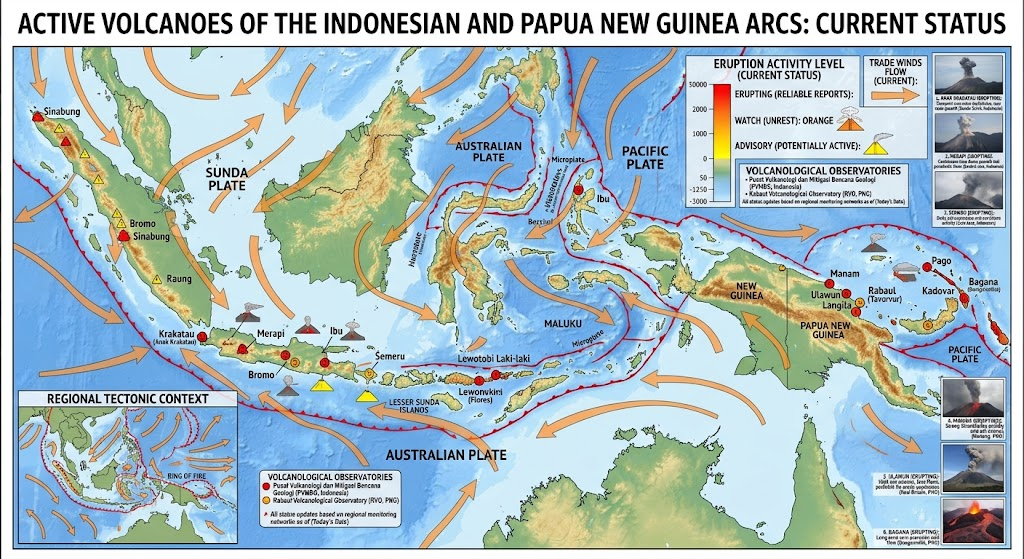
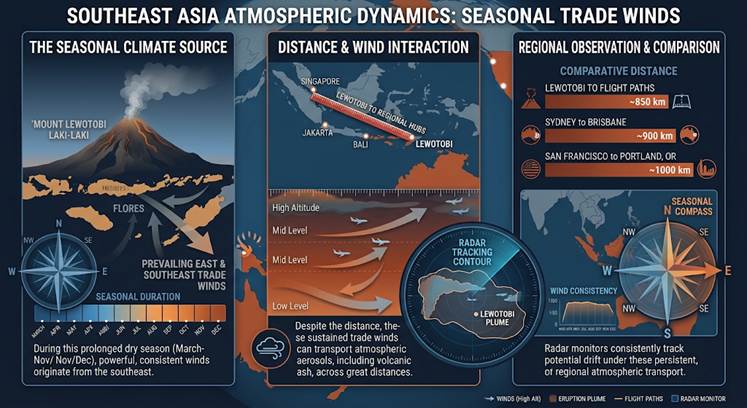
- Mount Lewotobi Laki-Laki (East of Bali): Lewotobi sits at the far eastern tip of Flores Island, roughly 800 to 850 kilometers (500 to 530 miles) away.
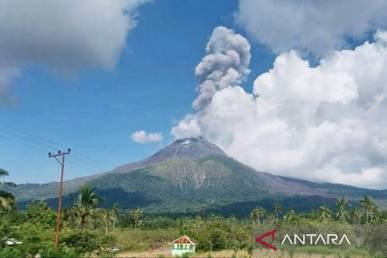
- Mount Lewotobi Laki-Laki erupting in Flores. Source: ANTARA News Ntt
- That is roughly the distance from Sydney to Brisbane, or San Francisco to Portland, Oregon.
- At this time of year—consistently from March through roughly November or December—the prevailing trade winds blow out of the East and Southeast. Lewotobi is far to the east, but despite its distance, high-altitude winds are the only reason radar monitors track its drift toward regional flight paths.
- Anak Krakatau (West of Bali): The other volcano dominating international headlines sits in the Sunda Strait, between Java and Sumatra. It lies 1,100 to 1,150 kilometers (680 to 715 miles) west-northwest of Bali—the equivalent of traveling from Sydney to Adelaide or flying from New York City to Atlanta.
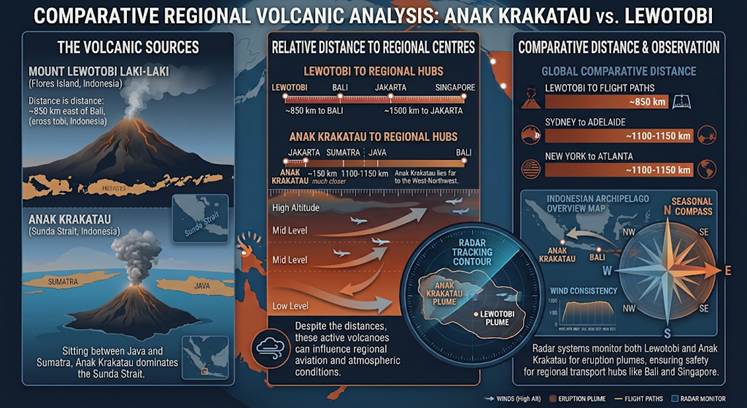
I remember boarding a flight in Kuala Lumpur when word spread that airports near Jakarta were temporarily affected; it had zero impact on my flight to Bali because Bali is an entire island chain away. Even there, activity has calmed significantly over the past 48 to 72 hours, with operations and air routes running normally.
Shifting Your Perspective
As Napoleon Hill famously wrote: “Every adversity carries within it the seed of an equal or greater benefit.”
If you have never witnessed the raw power of an active volcano safely from a distance, it is an awe-inspiring natural wonder that belongs on every adventurer’s bucket list. Flights to Jakarta, Sumatra, or the eastern reaches of the archipelago offer rare front-row seats to geology in motion.
Meanwhile, here in Bali, daily life remains safe, vibrant, and thriving.
Record Momentum on the Island
Far from suffering a downturn, tourism and hospitality across the island are seeing record demand. While lingering global geopolitical tensions and conflicts in the Middle East cause travel hesitation westward, they naturally keep travelers closer to home.
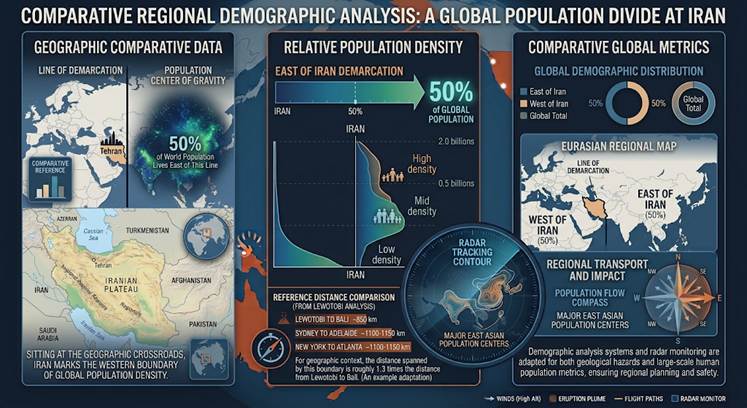
When you consider that over 50% of the world’s population lives east of Iran, Bali remains the premier, safe haven destination in the Asia-Pacific region. As predicted months ago, this shift has driven phenomenal regional interest—translating into four consecutive months of record occupancies across our hospitality portfolios, from our luxury private villas in Sanur to our upscale accommodations across the island.
Don’t let sensationalized news keep you from paradise. The island is welcoming visitors with open arms, blue skies, and warm hospitality—just as it always has.