
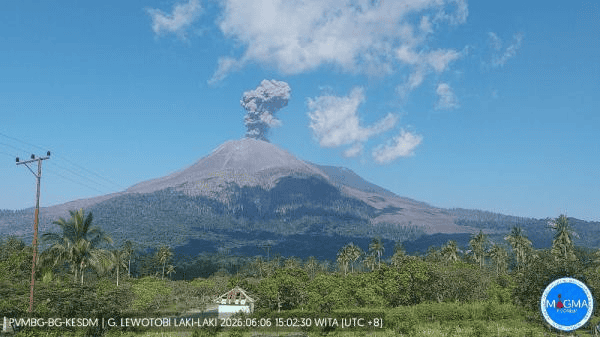
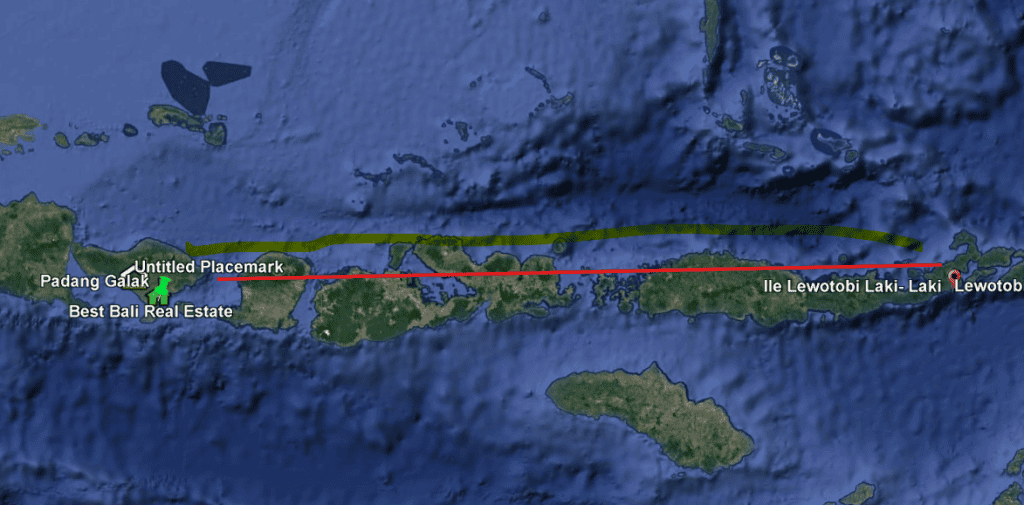
To the east of Bali on the island of Flores sits Mt. Lewotobi Laki-Laki. Located about 768 kilometers away, this active volcano has kept locals and geologists on alert with multiple eruptions over the last ten years.
Following a major escalation that began late last year, the volcano has continued to experience frequent explosive activity into June 2026.
The volcano, which is 768 km from Bali to the east has erupted several times in the last decade..
Current Status & Impacts
- Ongoing Eruptions: The volcano remains under a Level III (Siaga/Standby) alert status. Just over the last week, it has recorded more than a dozen distinct eruptive events.
- A notable eruption on June 5, 2026, sent a thick volcanic ash column 2.5 kilometers into the sky, followed by another significant burst today (June 9) that reached roughly 1,000 meters above the summit.
- Ash Haze & Wind Drift: The prevailing winds are currently pushing these thick, gray ash clouds primarily toward the west and southwest. This is causing localized ashfall and a heavy, hazy blanket over nearby villages and communities situated downwind.
- Travel Disruptions: Due to the airborne ash and reduced visibility, aviation authorities have had to repeatedly suspend operations at regional airports. For instance, the Fransiskus Xaverius Seda Airport in Maumere (located about 60 kilometers west of the crater) was forced to temporarily close due to the ash hazard drifting into its airspace.
Volcanologists at the Center for Volcanology and Geological Hazard Mitigation (PVMBG) have maintained a strict 5-kilometer exclusion zone around the crater.
Local residents and travelers in the downwind path are being advised to wear masks to protect against the fine volcanic particulate haze and to monitor nearby river channels for potential lahar (cold lava mudflows) if heavy rains occur.